Friday, July 13, 2012

Touring Sagittarius

Tuesday, June 10 was an exceptionally clear night.  Unfortunately, we had only 1.5 hours of true darkness before the last quarter moon crashed the party at around 12:30am.  We did a bit of visual observing since Randy adjusted the Meade RCX400's focus from "oooh, that's cool"  to "Holy Crap!" sharp.


Then we strapped my D90 with the business end of the William Optics Gran Turismo 81mm f9 telescope attached to the top of the RCX and got to work.  These images could have used quite a few more frames to stack but with the moonrise in 1 hour, time was of the essence.  I'd like to try again closer to the new moon.

Touring around the busy galactic center.  First we hit the Omega or Swan Nebula (M17) which, as you can see, is a nifty shaped star forming H II region located in the densely populated constellation Sagittarius.  I flipped this image 180 degrees to better show the "swan" shape

8, 1min frames stacked with DeepSkyStacker

The nearby Lagoon Nebula (M8),  also found in Sagittarius is a gorgeous emission nebula churning out stars like a champ.
6, 1min frames stacked with DeepSkyStacker

Just above Sagittarius in the constellation Serpens lies the Eagle Nebula.  The Pillars of Creation create that tiny silhouette of an eagle soaring upward clutching a fish.  An interesting fact (I just learned) is that the pillars have likely been destroyed by a supernova that could have been seen from Earth 1000-2000 years ago.  The light is just now reaching us from approx 6000 light years (35,271,752,239,101,650 miles!!!) away.
The mind-boggling size and distance of cosmic objects means that most of the things we see are drastically changed or completely gone at the same moment we are viewing them.

4, 1min frames stacked with DeepSkyStacker

This is the epic Sagittarius Star Cloud, a massive star field of many different kinds of stars giving it the many different colors.  This cloud is home to some of the oldest stars known.
1 min single exp


Monday, July 2, 2012

Milky WOW

Friday, June 29:

With a 10 day old moon setting at 2AM, I decided to head to the observatory, if only to visit with friends and relax a bit.  The sky was mostly overcast, even showing us a 22 deg Moon ring at one point.  As the Moon made it's final plummet around 1:30am the clouds parted and revealed a beautiful sky that was sooo worth staying up for.  We waited patiently for the clear sky to darken after Moonset and opened the roof.  We hopped around Cygnus, Cassiopeia, Andromeda, Lyra, and (of course) Sagittarius.  Notable views of Wild Duck (M11), Dumbell Nebula (M27), Ring Nebula (M57), Double Cluster, and the the gorgeous Andromeda Galaxy.  Unfortunately, it was too late and bright to do any astrophotography with the scope.

The stars started to dance in the eyepieces after about an hour of viewing as we were pushing 3:30am so we called it a night.  Before I packed up the gear I took a 180 degree Panorama of the milkyway from horizon to horizon.

10 frames @ 18mm 30sec f3.5 ISO1600


Here's a single frame I took of the Milky Way flowing through the Summer Triangle, which is made up of the stars Vega, Deneb, and Altair.  There's lots of great stuff in there but look hard in this frame to find Brocchi's cluster, aka: the "Coathanger Cluster.

18mm 30sec f3.5 ISO2000

Wednesday, June 13, 2012

I Bode you Good Night!

I've had these shots sitting neglected on my hard drive for nearly a month, don't know how they slipped my mind.  It was May 17th, and it was a fantastic night of brilliantly clear dark skies, many scopes, and good company out at the Observatory at Bisbee Hill.  Tonight looks like another one of those nights and I'm trying my best to not run out the door as I'm sure a good crew is out there right now (I have to drive to Philadelphia in the morning or I definitely would be out there!)  Hopefully the skies will hold this weekend.

This is a couple really long exposures showing the astronomers (and the stars) in action.
one 15 min exposure

and 30 min


Then I strapped my camera to the big scope and pointed it at a spectacular pair located in Ursa Major.  M81 and M82 also known as Bode's Galaxy and Cigar Galaxy are quite a dynamic duo.  M81 is a very large face on spiral galaxy and M82 is a unique starburst galaxy that is churning out stars on a massive scale being helped along by tidal forces from it's large neighbor M81.  There's a small galaxy on the lower left called NGC 3077, it's is also an irregular galaxy likely being acted upon by it's larger neighbor as well.

11 frames @  2min, f6, 81mm, ISO1600 , merged in DeepSkyStacker

Tuesday, June 5, 2012

Holey Sun Batman!

Somebody made quite an sacrifice to Ra because he was out in all his glory this evening for the Venus Transit at Presque Isle State Park.  After days of rain and cloud cover it cleared right in time for us to observe this twice in a lifetime event.  My head is throbbing from squinting behind viewfinders and lenses for hours but it was a now or never, I'm currently nursing it with a glass of wine (probably a bad idea but the Tequila has run dry).

The photography was difficult to say the least.  I used a variable neutral density filter to block most of the light from the sun.  I should have sprung for a BAADER filter (google it) but alas they were either sold out or over-budget.  I did my best to get a good focus with my 300mm, set my intervalometer to 1 min intervals, and set the camera to 1/100sec @ f14.  I then mingled with the shockingly huge crowd only to return to the camera and recenter the sun in the frame.

Here's a few of the shots I quickly browsed and edited from 300+ images.
Second Contact "black drop effect"

199 frame time-lapse.  Not nearly as impressive as some other amateur video's I've seen but it's mine.
The dim moving smudges are from the large cottonwood seeds floating in the air.  I love the atmospheric ripples as sunset nears at the end.

Re-edited the time lapse. I either need better video editing software or better skills but I'm satisfied with this last version.  If anyone knows any software that will perfectly align multiple frames for time lapse videos, do tell.


And I nabbed a green flash as the the sun sank! 

Monday, May 28, 2012

Lightning and light pollution

On Friday 5/25/12 our area was hit with some very severe weather but it was supposed to clear quickly afterward.  So, not willing to waste a day off, I decided to head out to the observatory to wait out the storm.  With the 360 degree view at a nice elevation it is perfect storm watching site as well.  The storm was in full swing when I arrived but it wasn't on top of us yet.  I quickly set up the tripod and using my shutter release to  keep the shutter going at 30 sec exposures, it was dark so no need to worry about over exposure.

Lightning is one of the most impressive and surprisingly one of the easiest things to photograph if you don't over think it.  Don't waste your time trying to snap as it happens, you'll only frustrate yourself.  If you have a nighttime storm just set up a tripod and shoot continuously at 30 sec with a wide aperture, pour some wine and get comfy (and safe).  For a daytime storm close the aperture and use shorter exposure times.   Just make sure to grab your gear when the rain hits if you don't have a rain cover (link is the super cheap one I use).

As the night went on the storm moved south and the stars were visible above the thunderheads. Saturn and Spica are the most prominent objects above the clouds. All these shots were taken between 11pm and 1am.

Here's best shots out of 200 or so:


This is the shot I was waiting for!

Bright stars on the left are Saturn (upper) and Spica (lower)


When the sky finally cleared it was such low transparency and seeing was so poor that we didn't even bother opening the observatory roof.
  
__________________

With summertime nearing, the Milky Way has been rising in time for some interesting photo ops.  I've been trying to get a shot of the Milky Way arching over this particular dirt road or weeks and after 3 different tries I have something finally worth showing.   Last night (5/27/12) I returned to this site located near the very rural Spartansburg, PA.  While very rural you can still see the dramatic effects of light pollution.  I'm anxiously awaiting the airing of the documentary The City Dark on PBS on July 5.  I strongly urge you to watch and in the meantime, if you must have glaring property lights get some motion detectors or sky friendly fixtures and bulbs.  Reconnect with the stars, there's a whole Universe out there.  People need to realize we're part of something much bigger.

TURN THE LIGHTS OUT!
180 degrees, from Cassiopeia to Scorpius


Sunday, May 20, 2012

Eclipse-ish

As I'm watching all the breathtaking "Ring of Fire" shots roll in across the interwebs, I can't help but get a little jealous.  There's some great shots out there, go check Google.

This was the maximum eclipse here in NW Pennsylvania before it headed further west.

Monday, May 14, 2012

Supermoon, Sun rings, and Sunspots...Oh my!

I have had zero time to sit down and put some words with some pictures here (I actually don't really have the time right now) but things are getting backed up so I must play some catch up here.

Lets start with last week's so-called "Supermoon!".  Not to burst anyone's bubble but it was just another full moon.  However, the full moon is always a beautiful sight so anything that gets regular folks interested in looking up at the night sky, histerical claims or not,  I'm all for it!  So, no massive earthquakes or tidal waves, just a perigee moon slightly bigger than normal.  I went out and shot it with my little future astrophysicist.

240mm, f10, 1/10, ISO100
 This one was fun.  "oooh, so close...to the right, no left... good,now up, little more...leeetle more, ooh perfect!  Now look at me...and freeze"  She's very patient sometimes.
135mm, f4.2, 1/25, ISO1250


On May 12th (My mother's birthday) there was an interesting show in the daytime sky.  A 22 degree halo or a "neat rainbow ring around the Sun" that lasted hours into the afternoon.  This allowed for some interesting distractions from my yard work.

This first one is a shot I took advantage of and framed for my Mother's day present.
18mm, f10, 1/400, ISO100

It's a good idea to block the full midday Sun from your eye as well as your camera's sensor.
18mm, f10,1/400, ISO100
As I was pointing my camera at the Sun I thought about the upcoming Venus transit (June 5th) and how I still haven't totally worked out how I'm going to shoot it (luckily it occurs at sunset so the full onslaught of solar rays won't be so harsh).  I ran inside to see what I could dig out.  I grabbed my ND400 filter and decided to go for it. 

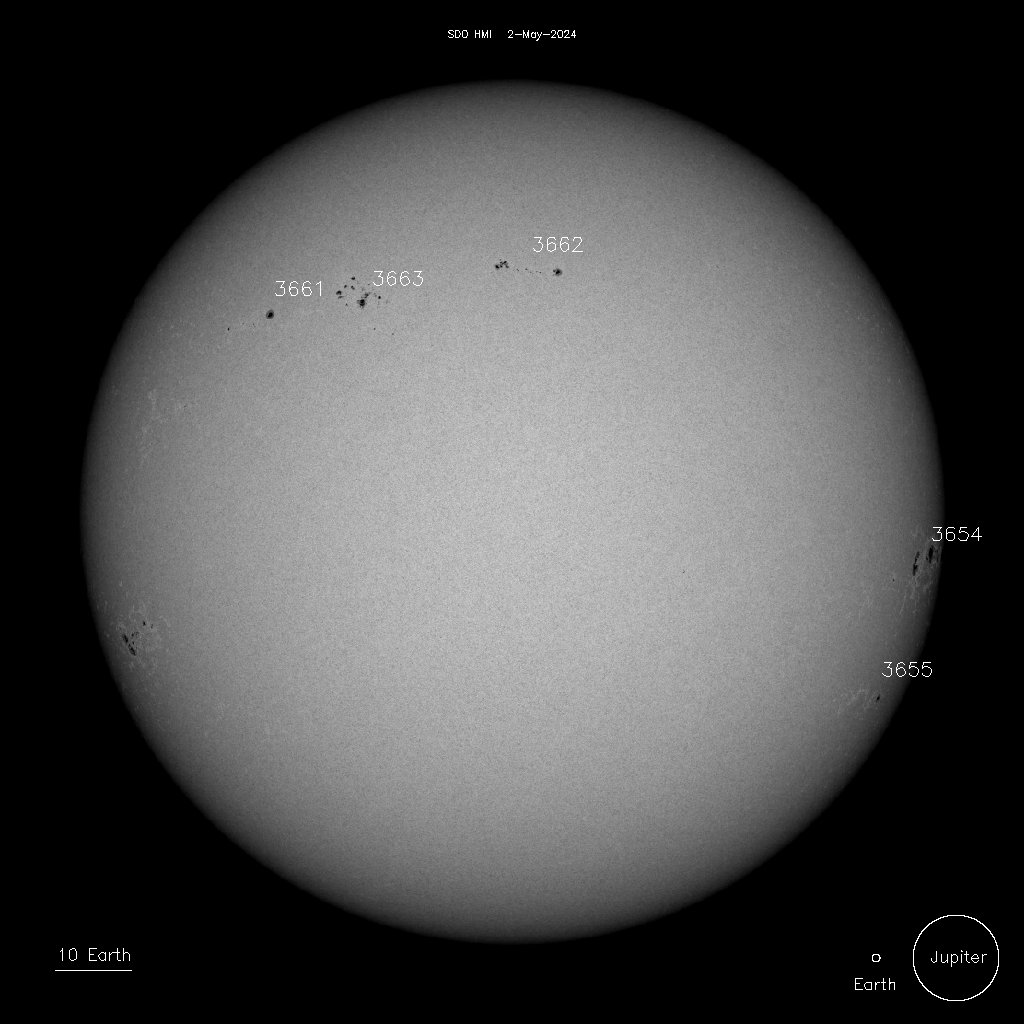
To gain some perspective on this region, our entire world easily fits inside that darker area in the middle of AR 1476, with room to spare.
ND400, 300mm, f14, 1/4000, ISO100 
 This hand held shot above clearly shows the large current active sunspot region 1476 along with other active regions.  This set up should definitely give me good results for shooting the Venus transit.  I'm planning on shooting from Presque Isle (Erie, PA) weather permitting (please permit!!).   This will occur again in 2117, so you can wait if you want...I don't plan on seeing that one.


The skies are clearing and this week looks very astronomically promising.  Sagittarius is rising earlier and earlier as summer nears so I plan on trying a Milky Way rise time lapse in the near future.  And of course I'll be posting the rapidly approaching Venus transit.  Stay tuned.

Clear skies!